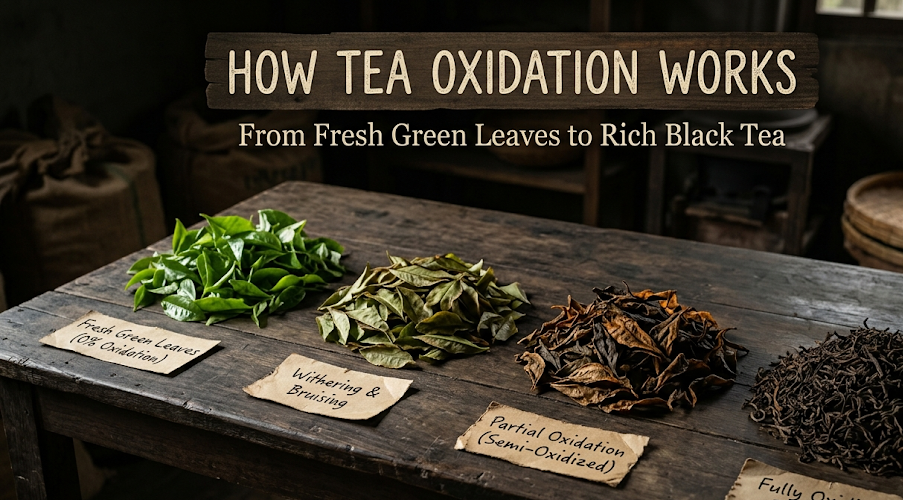
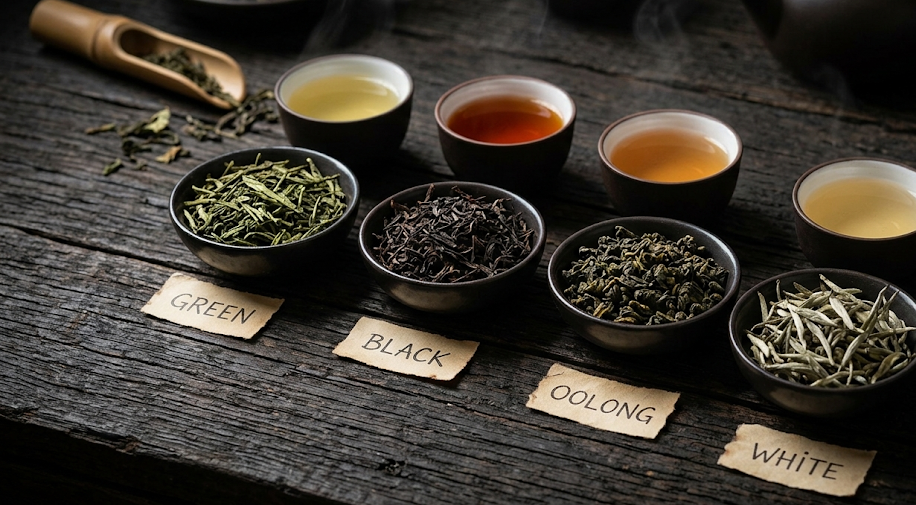
Oolong tea (Wu Long Cha) is universally revered among tea scientists and sensory sommeliers as the pinnacle of artisan tea craftsmanship. Falling between unoxidized green teas and fully oxidized black teas, oolongs occupy an expansive partial-oxidation continuum from roughly 15% to 80% oxidation. Yet what distinguishes oolong is not merely an arbitrary stopping point on an oxidation dial, but an extraordinarily demanding sequence of mechanical shaking, controlled bruising, and master-level charcoal roasting that coaxes hundreds of aromatic volatile compounds out of fresh leaf cells.
From the jade-green, floral, tightly balled high-mountain oolongs of Taiwan’s Ali Shan to the dark, mineral-drenched, heavily charcoal-roasted rock oolongs of Fujian’s Wuyi Mountains and the twisted honey-orchid Dan Congs of Guangdong’s Phoenix Mountain, the oolong spectrum represents an exquisite masterclass in biophysical stress chemistry.
The Four Great Oolong Terroirs and Processing Styles
Global oolong production is historically centered across four distinct geographic and stylistic regions, each possessing proprietary cultivars and processing architectures:
| Oolong Tradition | Key Cultivars | Oxidation Spectrum | Roasting Methodology | Sensory & Aromatic Signature |
|---|---|---|---|---|
| Southern Fujian (Anxi) | Tieguanyin, Ben Shan, Mao Xie | Light (15% – 25%) to Traditional (35%) | Unroasted (Qing Xiang) or heavy charcoal bake | Tightly rolled emerald balls; intoxicating floral orchid and jade jadeite freshness. |
| Northern Fujian (Wuyi Cliff) | Da Hong Pao, Rougui, Shuixian | Medium-High (50% – 70%) | Multiple slow charcoal roasts over longan wood | Twisted dark strips; deep mineral ‘rock bone’ (Yan Gu), cinnamon spice, roasted plum. |
| Guangdong (Phoenix Mountain) | Mi Lan Xiang, Ya Shi Xiang, Ba Xian | Medium (40% – 60%) | Light to medium charcoal firing | Twisted leaves; explosive singular aromatic profiles (honey orchid, ginger flower, almond). |
| Taiwan High Mountain (Gaoshan) | Qingxin, Jin Xuan (Milky Oolong) | Light (15% – 25%) | Minimal unroasted drying | Tight spherical beads; creamy butter, alpine pine mist, high-altitude floral clarity. |
| Taiwan Dong Ding & Oriental Beauty | Qingxin, Qingxin Damao (Bitten) | Dong Ding: 30-40%; Oriental Beauty: 70-80% | Dong Ding: heavy charcoal; Oriental Beauty: no roast | Dong Ding: roasted walnut; Oriental Beauty: wild Muscatel grape, ripe peach, natural honey. |
The Stress Chemistry of Oriental Beauty (Dongfang Meiren)
Perhaps no tea better illustrates the intersection of entomology and tea biochemistry than Taiwan’s legendary Oriental Beauty (Dongfang Meiren, or Bai Hao Oolong). This tea cannot be produced without the intervention of an agricultural pest: the tea green leafhopper (Jacobiasca formosana).
In early summer, swarms of miniature leafhoppers puncture the young tea shoots to suck phloem sap. In response to this mechanical insect wounding, the tea plant activates its systemic immune defense cascade, synthesizing volatile phytohormones and protective monoterpenes—most notably hotrienol and 2,6-dimethyl-3,7-octadiene-1,6-diol. When harvested and subjected to heavy oxidation (70% to 80%), these defensive compounds synthesize into intoxicating natural aromas of wild wildflower honey, muscatel wine, and ripe summer peaches without a single drop of artificial flavoring.
Balling and Rolling: Transforming Long Strips into Spherical Pearls
In Anxi and Taiwan, oolong leaves undergo a physical shaping process called Bao Rou (cloth-wrapped rolling). Large batches of warm, pliable leaves are bundled tightly into canvas bags, twisted into dense spheres, and loaded between mechanical pressing plates that roll and compress the mass under intense friction.
This grueling cycle is repeated 20 to 30 times, alternating between rolling, unbundling, reheating, and re-wrapping. The process ruptures internal cell vacuoles uniformly, redistributing sticky plant pectins across leaf surfaces and compacting the leaves into dense spherical pearls that uncurl dramatically across dozens of consecutive infusions in a Gongfu tea pot.
Biochemical Pathways: Polyphenol Oxidation Kinetics, HPLC Analytics, and Volatile Profiles
At the macromolecular level, the sensorial and pharmacological reality of Camellia sinensis is governed by complex biochemical reaction networks occurring during cellular senescence and thermal processing. Modern High-Performance Liquid Chromatography (HPLC) coupled with Gas Chromatography-Mass Spectrometry (GC-MS) has illuminated the precise molecular pathways responsible for astringency, umami, color depth, and volatile aromatic expression.
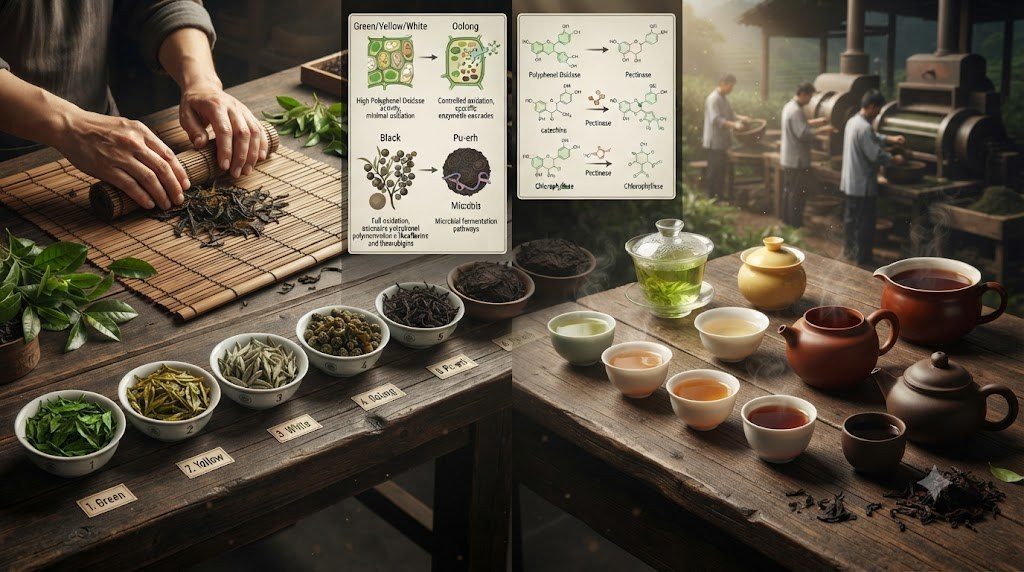
The primary reactive core resides within the flavan-3-ol family. In unprocessed fresh flushes, monomeric catechins constitute 25% to 35% of dry matter weight. Epigallocatechin gallate (EGCG) predominates (approximately 50-60% of total catechins), accompanied by epicatechin gallate (ECG), epigallocatechin (EGC), and epicatechin (EC). When cellular integrity is compromised, polyphenol oxidase (PPO, EC 1.14.18.1)—a binuclear copper metalloenzyme—catalyzes the aerobic oxidation of o-diphenols into highly reactive o-quinones.
| Analytical Metric / Fraction | Chromatographic Detection Standard | Biochemical Role in Liquor | Quantitative Typical Range (Dry Wt.) |
|---|---|---|---|
| EGCG (Epigallocatechin gallate) | HPLC at 280 nm / C18 reverse-phase | Primary antioxidant; sharp bitterness; astringent salivary protein binding. | 8.0% – 14.5% |
| L-Theanine (gamma-glutamylethylamide) | HPLC amino acid analysis / ninhydrin derivatization | Crosses blood-brain barrier; promotes alpha-wave relaxation; rich savory umami. | 1.5% – 4.2% |
| Caffeine (1,3,7-trimethylxanthine) | HPLC isocratic elution / UV detection at 272 nm | Purine alkaloid stimulant; clean bitter kick; forms theaflavin complexes. | 2.2% – 4.8% |
| Total Theaflavins (TF-1, TF-3, TF-3′, TFDG) | HPLC gradient elution / Flavognost colorimetry | Golden liquor rim; briskness index; mouthfeel clarity in black/oolong teas. | 0.5% – 2.0% |
| Volatile Monoterpene Alcohols | GC-MS with solid-phase microextraction (SPME) | Linalool, geraniol, nerolidol; floral, muscatel, and orchidaceous aromatics. | 150 – 450 ppm (total volatiles) |
Simultaneously, the enzymatic hydrolysis of non-volatile glycosidically bound volatiles (GBVs) by endogenous beta-glucosidases and beta-primeverosidases acts as a molecular release valve during leaf withering. Odorless disaccharide-bound glycosides stored within cell vacuoles are enzymatically cleaved, liberating fragrant volatile terpenes into the gaseous phase. This biochemical liberation explains why carefully withered leaves undergo an explosive aromatic metamorphosis from raw green grassy notes into intoxicating lilac, honey, and ripe peach bouquets.
Furthermore, the purine alkaloid caffeine forms reversible non-covalent hydrophobic and hydrogen-bonded complexes with theaflavins and thearubigins at temperatures below 40°C. This reversible thermodynamic aggregation is the direct physicochemical driver of “tea cream” (cream-down) in strong black tea infusions. Far from indicating defective quality, brilliant translucent tea creaming is the hallmark of high theaflavin purity and dense soluble solids.
Historical Case Studies: Terroir Lineages, Estate Archives, and Trade Chronicles
The contemporary agronomy and international connoisseurship of tea cannot be divorced from centuries of accumulated empirical trials, regional trade monopolies, and multi-generational agrarian lineages. Across the rugged river gorges of East Asia and the cloud-veiled ridges of the sub-Himalayas, specific micro-terroirs achieved legendary status through ruthless quality selection and codified processing protocols.
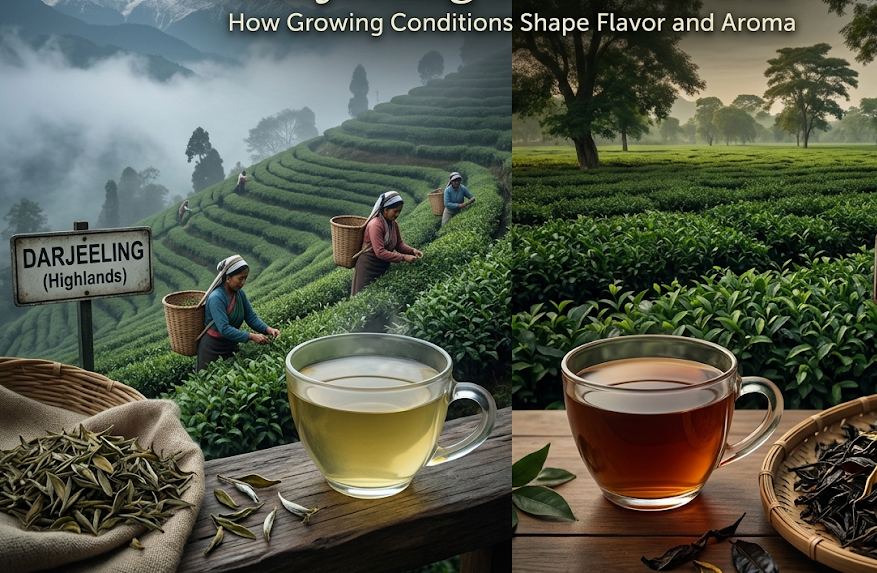
Consider the historic estate records of the Darjeeling Himalayan hills following the British East India Company’s mid-nineteenth-century clearances. Archival ledgers from landmark gardens such as Castleton, Makaibari, and Jungpana reveal that initial plantings struggled with harsh winter frosts and monsoonal soil erosion until master planters realized that high-elevation slopes (above 1,500 meters) combined with pure Chinese seed stock (Camellia sinensis var. sinensis) produced an ethereal, low-tannin flush with intense muscatel grape notes during the dry pre-monsoon spring. These early successes established the imperial Darjeeling auction benchmark at the London Royal Exchange, where single chests fetched unprecedented prices.
| Historical Terroir / Estate | Key Century / Era | Pioneering Technical Milestone | Historical Market Legacy |
|---|---|---|---|
| Beiyuan Imperial Gardens (Fujian) | Song Dynasty (10th–12th c.) | Pioneered hydraulic water-powered tea presses and micro-milled Dragon & Phoenix tribute cakes. | Established the courtly benchmark for imperial tribute tea and inspired Song Emperor Huizong’s treatise. |
| Makaibari Estate (Darjeeling) | Founded 1859 | Transitioned from colonial exploitation to pioneer of certified biodynamic and organic tea agronomy. | Produced historic record-breaking Silver Tips Imperial lots auctioned globally. |
| Wuyi Tianxin Monastery (Fujian) | Ming-Qing Era (17th c.) | First systematic refinement of partial oxidation and charcoal basket roasting (Kao Bei). | Birthplace of authentic Da Hong Pao parent bushes and the entire global Oolong category. |
| Uji Byodoin Environs (Kyoto) | Edo Period (17th–18th c.) | Nagatani Soen developed the Uji green tea hand-rolling method (Aomushi-seicha-sei) in 1738. | Replaced coarse boiled bancha with sweet, emerald sencha, sparking modern Japanese tea culture. |
| Menghai Tea Factory (Yunnan) | Established 1940 | Co-invented the accelerated microbial pile fermentation (Wo Dui) method in 1973 for ripe Pu-erh. | Created iconic vintage recipes (such as 7542 and 7572) that anchor modern pu-erh investment markets. |
Furthermore, maritime shipping logs from seventeenth- and eighteenth-century East Indiamen merchant vessels—such as the Royal Charlotte and Earl of Abergavenny—document the grueling six-month ocean journeys from Whampoa Anchorage around the Cape of Good Hope to London’s East India Docks. Tea chests were meticulously lined with hand-beaten lead sheeting and packed with dry river reeds to protect fragile leaves against humid ocean bilges and saltwater contamination. These historical preservation protocols directly spurred modern barrier packaging innovations.
The social geography of tea production also reflects profound labor transformations. From the indentured coolie labor systems of colonial Assam to the collectivized agricultural communes of mid-twentieth-century China, and finally to modern fair-trade cooperative estate ownerships, the human hands that pluck, wither, roll, and fire each shoot represent an unbroken chain of living agrarian heritage.
Sensory Evaluation Protocols: Laboratory Cupping, Analytical Refractometry, and Quality Assurance
To eliminate subjective bias and guarantee strict commercial consistency, international tea evaluation relies on rigorous standardized sensory and chemical benchmarking. The global gold standard is governed by the ISO 3103 specification (equivalent to BS 6008), which establishes reproducible thermodynamic and volumetric parameters for laboratory professional cupping across producing estates, export brokers, and research laboratories.
Under ISO 3103 protocol, exactly 2.0 grams (± 2%) of dry leaf per 100 mL of freshly boiled water are infused in a standardized porcelain tasting pot with a serrated drainage lid for exactly six minutes. The brewed liquor is decanted into an accompanying white porcelain tasting bowl, leaving the wet spent leaf (infused leaf or “outturn”) resting inverted on the upturned lid. Trained sensory panelists evaluate five distinct sensory dimensions: dry leaf morphology, liquor optical clarity, liquor aroma, liquor gustatory balance, and spent leaf elasticity.
| Sensory / Instrumental Attribute | Standardized Testing Parameter | Target High-Grade Metric | Analytical Quality Indication |
|---|---|---|---|
| ISO 3103 Infusion Ratio | 2.0g leaf per 100mL boiling distilled/soft water; 6 min steep | Standardized benchmark | Forces maximum polyphenol release to reveal underlying flaws, bitterness, and soil defects. |
| Digital Optical TDS (Refractometry) | Digital tea refractometer at 20°C temperature compensation | 0.35% – 0.75% TDS (liquor strength) | Quantifies total soluble dry matter mass transfer; verifies infusion efficiency. |
| Extraction Yield (EY%) | EY% = (Liquor Weight x TDS%) / Leaf Dry Weight | 18% – 24% Extraction Yield | Below 16% indicates under-extraction (thin, vegetal); above 25% marks astringency saturation. |
| Liquor Turbidity / Optical Hazing | Spectrophotometric transmission at 540 nm | > 92% light transmission at 60°C | High clarity signifies pristine processing; premature clouding reveals particulate dust or mineral issues. |
| Spent Leaf Tactile Elasticity | Physical finger compression of wet outturn | Supple, resilient, unburned leaf margins | Soft, elastic leaf tissue indicates gentle enzymatic fixing and skilled moisture regulation. |
Beyond optical refractometry, professional quality control incorporates gas chromatography olfactory ports (GC-O) to identify odor-active compounds responsible for prized varietal signatures or off-flavor taints. Compounds such as geosmin (musty, muddy taint from improper storage dampness) or 2,4,6-trichloroanisole (cork taint analogue from contaminated wooden packing cases) can be detected at parts-per-trillion thresholds before shipments leave origin ports.
Sensory profiling utilizes standardized Spider Web (radar) sensory graphs mapping six primary taste and aroma axes: Briskness, Floral Intensity, Sweet Umami, Bitterness, Astringency, and Lingering Throat Echo (Hui Gan). By plotting multi-infusion trajectories against these quantitative axes, blenders and master roasters create stable estate blends that withstand seasonal agricultural fluctuations.
Contemporary Frontiers: Climate Resilience, Genomic Breeding, and Neurobiology
The global tea industry currently stands at the intersection of unprecedented climatic challenges and revolutionary biological breakthroughs. From shifting monsoon rhythms in South Asia to the mapping of the complete Camellia sinensis nuclear genome and clinical investigations into human cognitive neurobiology, the scientific understanding of tea is evolving at exponential speed.
Anthropogenic climate shifts are altering altitudinal lapse rates and monsoon arrival dates across traditional tea belts. Rising ambient temperatures accelerate insect pest cycles (such as the tea green leafhopper, Jacobiasca formosana) and provoke erratic rainfall patterns that disrupt delicate spring flush flushes. In response, leading tea research institutes—such as the Tea Research Association (TRA) at Tocklai in India and the Tea Research Institute of CAAS in Hangzhou—are deploying high-throughput marker-assisted selection (MAS) and genome-wide association studies (GWAS) to breed drought-tolerant, frost-resilient, and high-polyphenol cultivars.
| Scientific Research Domain | Modern Technological Tool / Methodology | Breakthrough Finding / Innovation | Agronomic / Clinical Application |
|---|---|---|---|
| Genomic Architecture | High-coverage PacBio and Illumina whole-genome sequencing | Mapped 3.0 Gb genome of Camellia sinensis (cultivars ‘Shuchazao’ and ‘Yunkang 10’). | Identified gene duplication clusters governing terpene synthase (TPS) and catechin biosynthesis cascades. |
| Climate Adaptation Agronomy | Precision shade-net agroforestry and micro-drip fertigation | Intercropping with nitrogen-fixing leguminous trees buffers extreme thermal canopy spikes. | Maintains stable L-theanine and chlorophyll levels despite heat waves in low-elevation gardens. |
| Microbial Fermentation Metagenomics | Metatranscriptomics and HPLC-MS metabolomics | Uncovered non-toxic fungal enzyme cascades transforming tea polysaccharides into bioactive immunomodulators. | Standardizes sterile microbial inoculation for pharmaceutical-grade ripe pu-erh extracts. |
| Cognitive Neurobiology | Functional Magnetic Resonance Imaging (fMRI) & Quantitative EEG | L-Theanine crosses blood-brain barrier, synergizing with caffeine to elevate neural alpha-band waves (8-12 Hz). | Induces ‘relaxed alertness’, boosting working memory and sustained cognitive focus without jittery tachycardia. |
At the neurobiological level, the unique synergy between L-theanine (2-amino-4-(ethylcarbamoyl)butyric acid) and caffeine explains why tea induces a state of calm mental clarity distinct from coffee consumption. Caffeine acts as a non-selective antagonist of adenosine A1 and A2A receptors in the central nervous system, preventing drowsiness. Concurrently, L-theanine acts as a weak antagonist at AMPA and NMDA glutamate receptors, modulating glutamatergic neurotransmission and increasing brain concentrations of gamma-aminobutyric acid (GABA), dopamine, and serotonin.
This dual action produces a balanced neural frequency state characterized by elevated alpha waves (8–12 Hz), which are associated with relaxed alertness, creative flow states, and enhanced sensory perception. As clinical trials validate these neuroprotective and metabolic benefits, specialty tea is increasingly recognized not merely as a sensory luxury, but as an essential functional botanical for modern mental well-being.
Practical Implementation: Connoisseur Sourcing Protocols, Brewing Parameter Blueprints, and Technical FAQ
Translating theoretical tea science into exceptional daily practice requires clear operational blueprints. Whether managing a specialty tea bar, curating a private collection of aged cakes, or conducting precision home gongfu sessions, connoisseurs and professionals must adhere to systematic protocols covering cultivar authentication, storage preservation, water conditioning, and infusion timing.
The following multi-step checklist provides an objective framework for verifying leaf quality and maintaining optimal cellular integrity from purchase to final cup:
- Visual Inspection (Dry Leaf): Examine leaf uniformity, intactness of bud tips, pubescence density (Bai Hao), and color integrity. Reject lots showing uneven grayness, excessive crushed stalk dust, or unnatural artificial colorants.
- Aroma Activation (Warm Vessel Shake): Pre-heat a porcelain gaiwan or purple clay pot with boiling water, discard the water, and place dry leaves into the steaming interior. Close the lid for five seconds and gently shake. The trapped thermal vapor liberates base aromatic volatiles without extraction, revealing true terroir authenticity or hidden stale taints.
- Hydration and Expansion Monitoring: During the initial flash rinse, observe how leaves hydrate. Authentic high-mountain flushes unfurl gradually over multiple rounds; chemically treated or over-fired leaves shatter or release muddy pigment immediately.
- Long-Term Storage Control: Shield teas from oxygen, direct UV light, ambient moisture, and volatile kitchen odors. Store unoxidized Green and Yellow teas in vacuum-sealed nitrogen-flushed foil pouches at sub-zero temperatures (-18°C). Store Oolongs and Black teas at room temperature in airtight tin or double-lidded caddies. Store Pu-erh and Hei Cha in breathable, temperature-stable (20°C – 26°C), humidity-controlled (60% – 70% RH) cellars to nurture living aerobic microflora.
| Tea Classification Style | Recommended Vessel Type | Leaf-to-Water Ratio | Water Strike Temperature | Infusion Cadence (Flash Gongfu) |
|---|---|---|---|---|
| Delicate White (Silver Needle) | Glass pitcher or glazed porcelain gaiwan | 4g / 100mL (1:25) | 85°C – 90°C | 30s, 40s, 50s, 60s, 90s, 120s |
| Steamed Japanese Green (Sencha/Gyokuro) | Kyusu teapot with fine ceramic mesh | 5g / 100mL (1:20) | 60°C – 70°C (Gyokuro: 50°C) | 60s, 30s, 45s, 60s (rapid extraction) |
| Pan-Fired Chinese Green (Longjing) | Porcelain gaiwan or tall glass tumbler | 3.5g / 100mL (1:28) | 80°C – 85°C | 45s, 60s, 90s, 120s |
| Fragrant Strip Oolong (Dancong/Baozhong) | Porcelain gaiwan or Zhu Ni red clay pot | 7g / 110mL (1:16) | 98°C – 100°C (Boiling) | 10s, 15s, 20s, 25s, 35s, 50s, 70s+ |
| Charcoal Roasted Rock Oolong (Wuyi) | Zi Ni purple clay pot or thick gaiwan | 8g / 110mL (1:14) | 100°C (Rolling boil) | 15s, 20s, 25s, 35s, 50s, 70s, 90s+ |
| High-Altitude Black (Darjeeling First Flush) | Thin porcelain gaiwan or cupping set | 4g / 120mL (1:30) | 88°C – 92°C | 25s, 35s, 45s, 60s, 90s |
| Malty Full-Oxidation Black (Assam/Keemun) | Glazed stoneware or porcelain teapot | 5g / 120mL (1:24) | 95°C – 98°C | 20s, 30s, 40s, 60s, 90s |
| Aged Sheng & Shou Pu-erh Cakes | High-iron Zi Ni or Duan Ni clay pot | 8g / 110mL (1:14) | 100°C (Active rolling boil) | Flash rinse (5s), 10s, 15s, 20s, 30s, 45s, 60s, 90s+ (12+ rounds) |
Frequently Asked Technical Questions (FAQ)
Q1: Why does re-boiling water spoil the taste of fine tea?
A: Repeated or prolonged boiling depletes dissolved atmospheric gases, particularly dissolved oxygen (DO), which drops from approximately 9 mg/L at room temperature to near zero during prolonged boiling. Oxygen-depleted “flat” water dampens the aromatic volatile release and gives the tea liquor a dull, heavy mouthfeel. Always use freshly drawn, freshly heated spring water.
Q2: What causes the iridescent, oily film (‘tea scum’) on the surface of brewed tea?
A: Surface tea scum is not plant oil or chemical contamination; it is an insoluble calcium carbonate and polyphenol precipitate. When brewing water contains elevated calcium cations (Ca²⁺) and bicarbonate alkalinity, calcium reacts with oxidized polyphenolic catechins and atmospheric oxygen at the liquor surface, forming an insoluble crystalline complex. Switching to low-calcium soft water (< 30 ppm Ca²⁺) eliminates tea scum entirely.
Q3: How does the astringency of tea differ from bitterness in sensory neurobiology?
A: Bitterness is a true gustatory taste sensation detected by bitter taste receptors (TAS2Rs) on the tongue’s taste buds, triggered by caffeine, free amino acids, and monomeric catechins. Astringency is not a taste, but a tactile, trigeminal somatosensory sensation: high-molecular-weight polyphenols (such as epigallocatechin gallate and thearubigins) bind and precipitate lubricating salivary proline-rich proteins (PRPs) in the mouth, causing mucosal friction, puckering, and dryness.
Q4: Can post-fermented Pu-erh tea expire or go bad over time?
A: Under proper storage conditions (moderate humidity, adequate airflow, zero light, and absence of chemical odors), authentic post-fermented Sheng and Shou Pu-erh does not expire; rather, it undergoes living biochemical maturation. However, if relative humidity exceeds 85% without ventilation, harmful molds (such as Aspergillus flavus) can develop, rendering the tea unsafe. Properly aged pu-erh displays clean camphor, dried fruit, wood, and lotus aromas with zero sourness or mustiness.
Taxonomic Governance: Varietal Authentication, Grading Hierarchies, and Chemical Typicity
In the global marketplace, authenticating tea types requires rigorous analytical governance to prevent varietal fraud and misleading labeling. Standardized sensory grading systems evaluate leaf morphology, bud-to-leaf ratios, and polyphenolic profiles to classify teas into codified quality tiers.
For unoxidized and minimally oxidized white and green teas, the grading architecture is strictly anatomical. Imperial grade (such as Bai Hao Yinzhen or Longjing Pre-Qingming) consists exclusively of single tender terminal buds plucked before the spring solar terms, yielding maximal L-theanine and minimal bitter tannins. Secondary grades (Bai Mu Dan or Gong Mei in white tea; Yu Qian in green tea) incorporate one or two opening foliage leaves alongside the bud, introducing greater catechins, structural astringency, and richer amber color.
| Classical Tea Classification | Anatomical Plucking Standard | Primary Volatile Biomarkers | Sensory Defect Markers to Reject |
|---|---|---|---|
| Silver Needle White Tea | Pure terminal plump buds with intact silver pubescence. | Hexanoic acid ethyl ester, beta-ionone, floral lactones. | Yellowed oxidized leaf bases, broken buds, smoky or fermented odor. |
| Longjing Green Tea | One bud, one opening leaf (Pre-Qingming); flat smooth spears. | 2,5-Dimethylpyrazine (chestnut), (Z)-3-hexenol acetate. | Curled or twisted leaves, charred black tips, red stem oxidation. |
| Tieguanyin Oolong | One bud with 2-3 mature leaves; tightly rolled shiny balls. | Nerolidol, indole, farnesene, alpha-terpineol. | Open unrolled flakes, excessive woody stems, green raw sourness. |
| Wuyi Rock Oolong (Yancha) | Whole twisted leaves (strips); dark lustrous charcoal glaze. | Pyrazines, furans, beta-damascenone, maltol. | Scorched surface ash, sour grassy undertone, hollow thin liquor. |
| Dianhong Yunnan Black | Plump golden downy buds and twisted tender shoots. | Linalool, geraniol, benzaldehyde, phenylacetaldehyde. | Gray dull leaf color, sour unoxidized green fragments, burnt sugar. |
| Aged Ripe Pu-erh (Shou) | Compressed tight cake; uniform brown-red leaves with golden buds. | 1,2,3-Trimethoxybenzene, alpha-terpineol, beta-eudesmol. | White powdery mildew, sour damp mustiness, sour astringency. |
Ensuring varietal integrity across international supply chains also involves stable isotope ratio mass spectrometry (IRMS) and DNA barcoding (using rbcL and matK chloroplast genes). These cutting-edge analytical tools verify geographic provenance and cultivar purity, protecting heritage tea artisans from industrial counterfeiting and empowering global consumers to purchase authenticated single-origin teas with scientific confidence.