TEA TERROIR JOURNAL · ORIGIN & FLAVOR
Two Tea Regions. Two Distinct Personalities.
Discover why Darjeeling teas often taste delicate, floral, and complex, while Assam teas are celebrated for their rich body, malty character, and satisfying strength.
Two cups of black tea can look surprisingly similar while offering completely different drinking experiences.
One may have a light body, floral aroma, and delicate fruit-like notes.
Another may taste bold, malty, and full-bodied, with enough strength to stand up to milk.
Darjeeling and Assam teas provide one of the clearest examples of how growing conditions influence tea flavor.
Both originate in India, and both are produced from the tea plant, Camellia sinensis.
Yet their landscapes, climates, commonly cultivated tea varieties, and production traditions differ significantly.
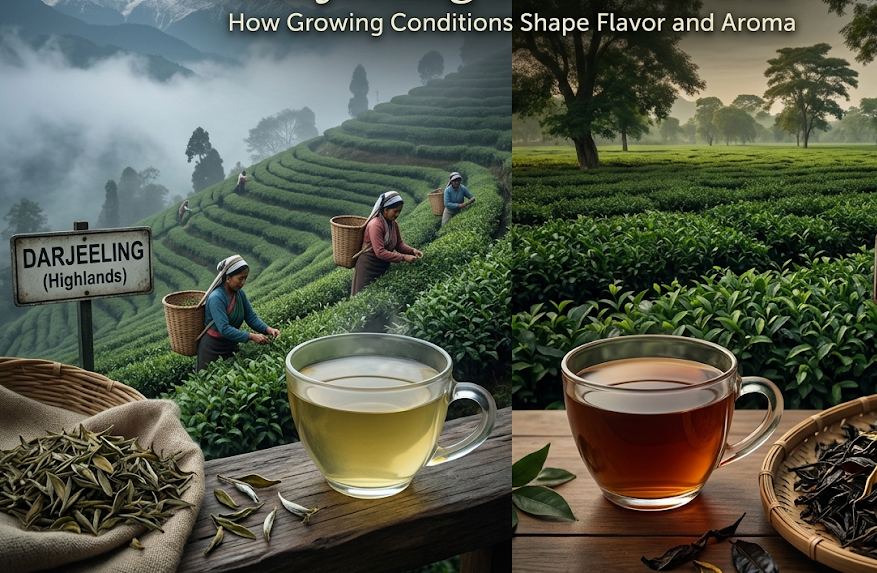
Darjeeling is associated with the cool, misty hills of the eastern Himalayas.
Assam is known for its warm, humid lowland tea-growing region in northeastern India.
These environmental differences influence how tea plants grow and how their leaves develop.
To understand Darjeeling and Assam tea, it helps to look beyond the finished cup and explore the landscapes where the leaves begin their journey.
Where Are Darjeeling and Assam Tea Grown?
Darjeeling tea is produced in a designated tea-growing area in the hills of West Bengal, India.
Its tea gardens occupy slopes with varying elevations, exposures, and local climates.
The region is famous for its mountain scenery, seasonal mist, and distinctive teas.
Assam tea comes from the northeastern Indian state of Assam.
Much of its commercial tea production takes place in relatively low-elevation areas influenced by the Brahmaputra Valley and surrounding landscapes.
The region experiences warm temperatures, substantial seasonal rainfall, and high humidity.
Both regions produce excellent tea, but their growing environments encourage different plant responses.
Darjeeling’s cooler hill conditions often contribute to slower seasonal growth.
Assam’s warmer conditions can support vigorous leaf development during favorable growing periods.
These differences help explain the contrasting characteristics of the finished teas.
REGION 01 / MOUNTAIN TEA
Darjeeling
Landscape: Himalayan foothills and mountain slopes
Climate: Cooler conditions with seasonal mist and rainfall
Typical cup: Fragrant, nuanced, often floral or fruity
REGION 02 / VALLEY TEA
Assam
Landscape: Predominantly lowland tea-growing areas
Climate: Warm, humid, and influenced by monsoon rainfall
Typical cup: Rich, malty, robust, and full-bodied
Why Altitude Matters in Tea Growing
Altitude is one of the most noticeable differences between many Darjeeling and Assam tea gardens.
Higher elevations often have cooler average temperatures than nearby lowlands.
Cooler conditions can slow tea plant growth, particularly during certain parts of the year.
Slower growth may influence leaf chemistry and the development of flavor compounds.
In Darjeeling, these conditions contribute to the distinctive character associated with many mountain-grown teas.
However, altitude does not automatically make tea better.
It changes the growing environment and can influence the style of tea produced.
Assam’s lower-elevation tea-growing areas experience warmer conditions that support different growth patterns.
Those conditions help make Assam well suited to producing the strong, richly flavored teas for which it is known.
Elevation is therefore best understood as one influence among several, rather than a simple measure of quality.
How Temperature Changes Tea Leaf Development
Tea plants respond to temperature because it affects photosynthesis, metabolism, and growth.
During cooler periods, growth may slow considerably.
When favorable temperatures return, plants may produce fresh shoots that are harvested for tea.
In Darjeeling, seasonal temperature changes help create distinct harvesting periods known as flushes.
Leaves harvested during different flushes can have noticeably different aromas and flavors.
Assam generally experiences warmer growing conditions, although its seasonal weather still changes throughout the year.
Its tea plants can produce substantial growth during suitable warm and wet periods.
These differences influence harvesting schedules and the characteristics of the leaves available for processing.
Temperature alone does not determine flavor, but it plays an important role in the conditions under which flavor develops.
The Role of Rainfall, Mist, and Humidity
Tea plants require adequate moisture to support healthy growth.
Rainfall patterns affect water availability, leaf production, and seasonal harvesting conditions.
Darjeeling’s hills experience changing weather influenced by elevation, cloud cover, and monsoon rainfall.
Mist and cloud cover can reduce direct sunlight during certain periods.
These conditions contribute to the region’s distinctive growing environment.
Assam’s humid climate and substantial rainfall support vigorous tea cultivation.
However, excessive rainfall can also create challenges, including waterlogged soils and difficulties during harvesting or processing.
The timing of rainfall matters as much as the total amount.
A dry period followed by favorable growing conditions can produce a different leaf character from a period of continuous wet weather.
This is one reason tea from the same garden may taste different across the year.
Tea Plant Varieties: Another Important Difference
Growing conditions are not the only reason Darjeeling and Assam teas taste different.
The genetic characteristics of the tea plants also matter.
Darjeeling gardens have historically cultivated many plants associated with the smaller-leaf Chinese variety of Camellia sinensis, along with hybrids and other selected cultivars.
Assam is strongly associated with the larger-leaf Assam variety, commonly called Camellia sinensis var. assamica.
These plant types can differ in growth habits, leaf characteristics, and chemical composition.
However, tea-growing regions do not use only one plant type.
Different cultivars and clonal selections are grown according to local conditions and production goals.
Consequently, regional flavor is the result of plant genetics interacting with climate, soil, cultivation, and processing.
TEA TERROIR INSIGHT
Flavor Comes from More Than Geography.
Climate, elevation, tea plant genetics, soil conditions, harvesting season, and processing methods work together to shape the final cup.
Darjeeling First Flush vs. Second Flush
Darjeeling is especially famous for the differences between its seasonal harvests.
The first flush generally occurs during spring, when fresh growth emerges after the cooler season.
First-flush Darjeeling teas are often lighter in body and may display floral, fresh, or gently vegetal characteristics.
Many first-flush teas are processed with relatively limited oxidation, giving them a lighter appearance than conventional fully oxidized black teas.
The second flush generally takes place in late spring and early summer.
These teas are often fuller in body and may develop fruity, sweet, or muscatel-like characteristics.
Muscatel is a tasting term used for certain distinctive fruity and aromatic qualities associated with some Darjeeling teas.
Not every second-flush tea develops a pronounced muscatel character.
Later seasonal harvests can produce other flavor profiles.
The important point is that Darjeeling tea is not one fixed flavor.
Its character changes with season, garden, weather, and processing.
Why Assam Tea Is Known for Its Malty Flavor
Assam black tea is widely recognized for its strong body and malty character.
In tea tasting, malty describes an aroma or flavor that can suggest cereal, toasted grain, or a rich, rounded sweetness.
These characteristics develop through the interaction of leaf chemistry and processing.
Assam’s commonly cultivated tea plant varieties, warm growing environment, and black tea production methods all contribute to the region’s recognizable style.
Many Assam teas also have a brisk quality.
Briskness describes a lively, refreshing sensation that may include noticeable astringency.
Some Assam teas are particularly suitable for breakfast blends because their flavor remains prominent when milk is added.
However, Assam also produces more delicate and complex orthodox teas that can be enjoyed without milk.
Its reputation for strength should not obscure the diversity of teas produced in the region.
How Processing Changes the Flavor
After harvesting, tea leaves undergo processing that strongly influences their final character.
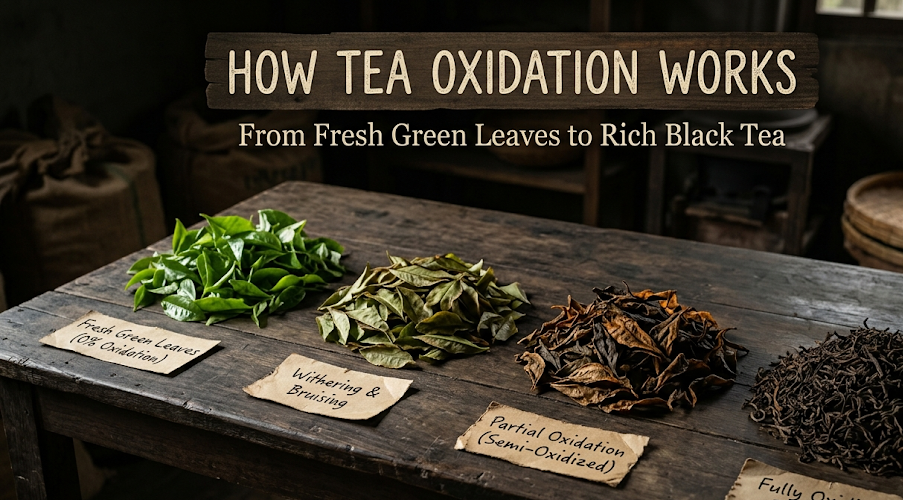
For black tea, common processing stages include withering, rolling or other leaf disruption, oxidation, and drying.
During oxidation, enzymes in damaged tea leaves react with compounds in the leaf.
These reactions contribute to changes in color, aroma, and flavor.
Darjeeling teas are often produced using orthodox processing methods that preserve recognizable leaf shapes.
Assam produces both orthodox teas and CTC teas.
CTC stands for crush, tear, and curl.
This method produces small, relatively uniform tea particles that can brew quickly and create a strong liquor.
CTC Assam is commonly used in milk tea and breakfast blends.
Orthodox Assam may offer a different balance of body, aroma, and complexity.
Therefore, two teas from the same region can taste different simply because they were processed differently.
Darjeeling vs. Assam Tea: Flavor Comparison
| Characteristic | Darjeeling Tea | Assam Tea |
|---|---|---|
| Growing landscape | Mountain slopes | Predominantly lowland tea areas |
| Typical body | Light to medium | Medium to full |
| Common aromas | Floral, fruity, fresh | Malty, rich, sometimes sweet |
| Flavor character | Delicate and nuanced | Bold and rounded |
| Popular drinking style | Often enjoyed plain | Often enjoyed plain or with milk |
| Common uses | Single-origin tasting | Single-origin tea, breakfast blends, milk tea |
These are broad tendencies rather than strict rules.
A strongly oxidized Darjeeling may have more body than expected.
An carefully produced orthodox Assam may be more aromatic and delicate than a typical breakfast blend.
Individual teas should be judged by their actual flavor rather than regional stereotypes.
Does Soil Influence Darjeeling and Assam Tea?
Soil conditions influence tea plant health, nutrient availability, drainage, and root development.
Tea plants generally grow well in appropriately acidic soils with suitable drainage.
Darjeeling’s sloping terrain can create differences in drainage, soil depth, and exposure between gardens.
Assam’s tea-growing landscapes include different soil types and local drainage conditions.
These factors influence cultivation practices and plant growth.
However, claims that a particular mineral directly creates a specific flavor note should be treated cautiously.
The relationship between soil and flavor is complex.
Soil influences the plant’s growing environment, but finished tea flavor also depends on genetics, weather, harvesting, and processing.
Which Tea Is Better for Milk Tea?
Assam is often a practical choice for milk tea.
Its fuller body and malty flavor can remain noticeable after milk is added.
Strong Assam CTC teas are particularly popular for this purpose.
They brew quickly and produce a concentrated infusion.
Darjeeling is more commonly appreciated without milk, especially when the goal is to experience its delicate aromas.
Adding milk to a light first-flush Darjeeling may mask some of its subtle floral notes.
However, personal preference matters.
Some fuller-bodied Darjeeling teas can be enjoyed with a small amount of milk.
There is no universal rule that every tea must be prepared in only one way.
How to Brew Darjeeling and Assam Tea
Brewing conditions influence how tea flavor develops in the cup.
Water temperature, leaf quantity, and steeping time all affect extraction.
For a delicate first-flush Darjeeling, slightly cooler water may help preserve a balanced flavor.
Many drinkers begin around 175–195°F (80–90°C), depending on the tea.
For fuller-bodied Darjeeling black teas, hotter water may be appropriate.
Assam black tea is commonly brewed with water near 195–212°F (90–100°C).
A starting steeping time of approximately three to five minutes is common for many loose-leaf black teas.
However, smaller CTC particles may extract more quickly.
Always consider the producer’s brewing guidance.
Adjusting the time and temperature can help control bitterness, astringency, and strength.
TEA BREWING / STARTING POINTS
Start with moderately hot water and a shorter infusion. Adjust to preserve floral and fresh notes.
Use hot water and adjust steeping time for the desired strength, especially when adding milk.
Brewing preferences vary by leaf grade, processing style, and personal taste.
How to Taste the Difference Yourself
One of the best ways to understand these teas is through a simple side-by-side tasting.
Choose an unflavored Darjeeling and an unflavored Assam.
Use similar leaf quantities and prepare each tea according to its recommended brewing instructions.
Begin by observing the dry leaves.
Notice their size, shape, and aroma.
After brewing, compare the color and fragrance of each infusion.
Take a small sip without adding milk or sugar.
Pay attention to body, sweetness, astringency, and lingering flavor.
Darjeeling may reveal floral or fruit-like characteristics.
Assam may feel rounder, richer, or more malty.
Repeat the tasting with different flushes or processing styles.
This helps demonstrate how much variation exists within each region.
How to Choose Between Darjeeling and Assam
If you enjoy lighter, aromatic teas with subtle flavor changes, Darjeeling is worth exploring.
Its seasonal harvests offer opportunities to compare floral, fruity, and muscatel-like characteristics.
If you prefer a stronger, richer cup, Assam may be a better starting point.
Its malty character works particularly well for breakfast tea and milk-based preparations.
For a more complete experience, try both orthodox and CTC Assam.
Also compare first-flush and second-flush Darjeeling.
These tastings reveal that the differences between individual teas can be as interesting as the differences between regions.
Frequently Asked Questions
Is Darjeeling tea stronger than Assam tea?
Assam is generally known for a fuller body and stronger flavor, while many Darjeeling teas are lighter and more aromatic. Individual teas vary.
Why does Darjeeling tea taste floral?
Its aroma reflects tea plant genetics, seasonal growing conditions, leaf chemistry, and processing methods.
Why is Assam tea often described as malty?
Many Assam black teas develop rich, grain-like flavor characteristics through the interaction of plant variety, growing environment, and oxidation.
What is muscatel flavor in Darjeeling tea?
Muscatel describes a distinctive fruity and aromatic quality found in some Darjeeling teas, particularly certain second-flush examples.
Which tea is better with milk?
Assam is often preferred because its robust flavor can remain noticeable when milk is added.
Does Darjeeling tea contain caffeine?
Yes. Both Darjeeling and Assam teas naturally contain caffeine. The amount in a brewed cup varies with the leaves and preparation method.
Are Darjeeling and Assam made from different plants?
Both come from Camellia sinensis, but the regions commonly cultivate different varieties, hybrids, and selected cultivars.
Final Thoughts
Darjeeling and Assam demonstrate how strongly a tea’s origin can influence its character.
Darjeeling’s mountain growing conditions, seasonal temperature changes, and production traditions help create teas known for delicate aromas and nuanced flavors.
Assam’s warmer, humid growing environment and commonly cultivated tea varieties contribute to teas recognized for their richness, body, and malty character.
However, geography is only part of the story.
Tea plant genetics, harvesting season, leaf handling, oxidation, and brewing methods all influence the final cup.
That is why no single description captures every Darjeeling or Assam tea.
The best way to appreciate their differences is to taste several examples and pay attention to how aroma, body, and flavor change.
Whether you prefer a fragrant mountain tea or a bold breakfast cup, both regions offer distinctive expressions of the same remarkable plant.