THE TEA TASTING JOURNAL / LEAVES & FLAVOR
Four Teas, One Plant, Remarkably Different Cups
Discover how oxidation, harvesting, and processing transform tea leaves into delicate white tea, refreshing green tea, layered oolong, and bold black tea.
Walk into a specialty tea shop, and you may find shelves filled with green, black, oolong, and white teas. Some have fresh grassy aromas, others smell floral or fruity, and a few produce rich cups with notes resembling toasted nuts, honey, or malt.
Despite these differences, the four major tea categories share a surprising connection: they all come from the same plant species, Camellia sinensis. Their distinctive characteristics develop primarily through differences in harvesting, processing, and oxidation.
Understanding these differences makes choosing tea much easier. Rather than relying only on color or packaging descriptions, you can learn how each tea is made and what kind of flavor experience it is likely to offer.
This guide explores the defining characteristics of green, black, oolong, and white tea, including their processing methods, caffeine content, brewing needs, and practical uses.
One Plant Behind Four Tea Traditions
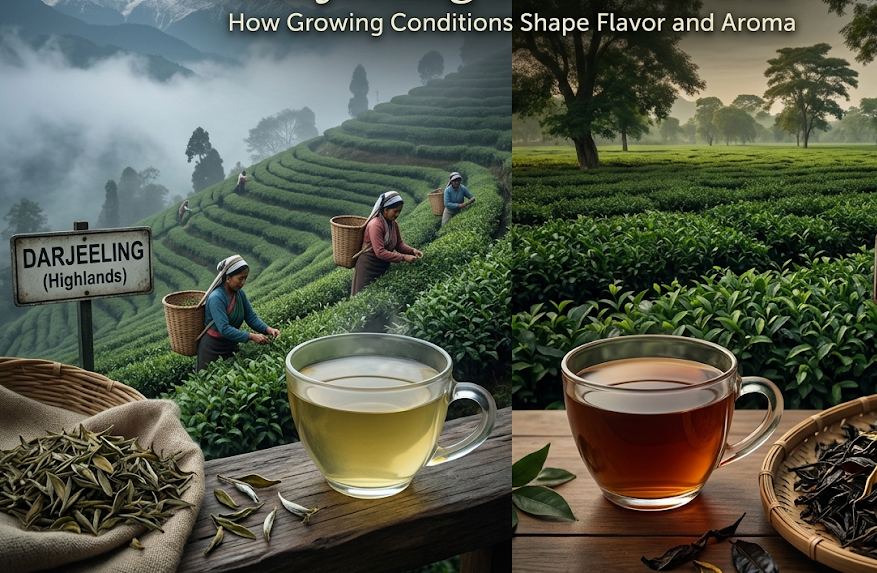
True tea comes from the leaves and buds of the tea plant, Camellia sinensis. Different varieties, growing conditions, and harvesting practices influence the flavor of the finished tea.
Climate, elevation, soil, and seasonal weather can all affect leaf development. Processing then shapes the tea’s aroma, appearance, and chemical composition.
This is why two teas from the same broad category may taste very different. A Japanese steamed green tea, for example, can have a noticeably different flavor from a Chinese pan-fired green tea.
Herbal infusions such as peppermint, chamomile, and rooibos are commonly called teas, but they do not come from Camellia sinensis. They belong to a separate category of beverages often called herbal tisanes.
TEA FUNDAMENTALS
The Biggest Difference Is Often What Happens After the Leaves Are Picked.
Harvesting choices, oxidation, heating, rolling, and drying influence the finished tea’s color, aroma, texture, and taste.
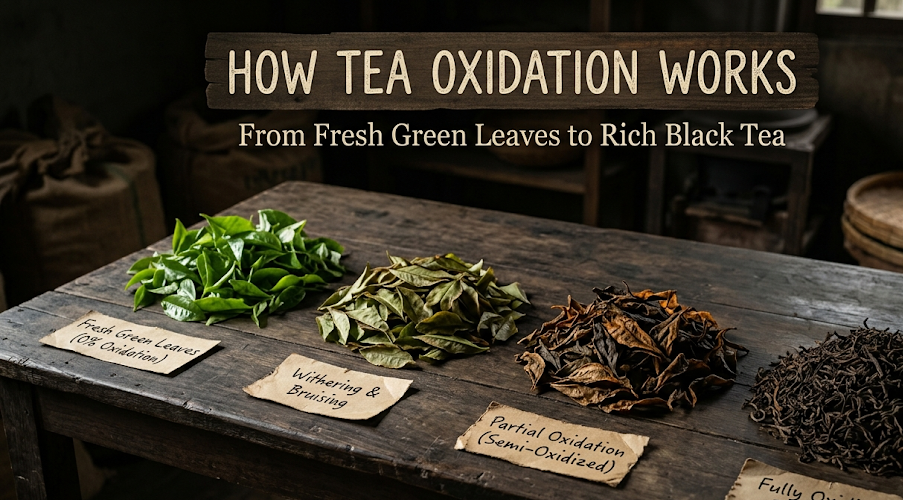
What Is Oxidation in Tea Processing?
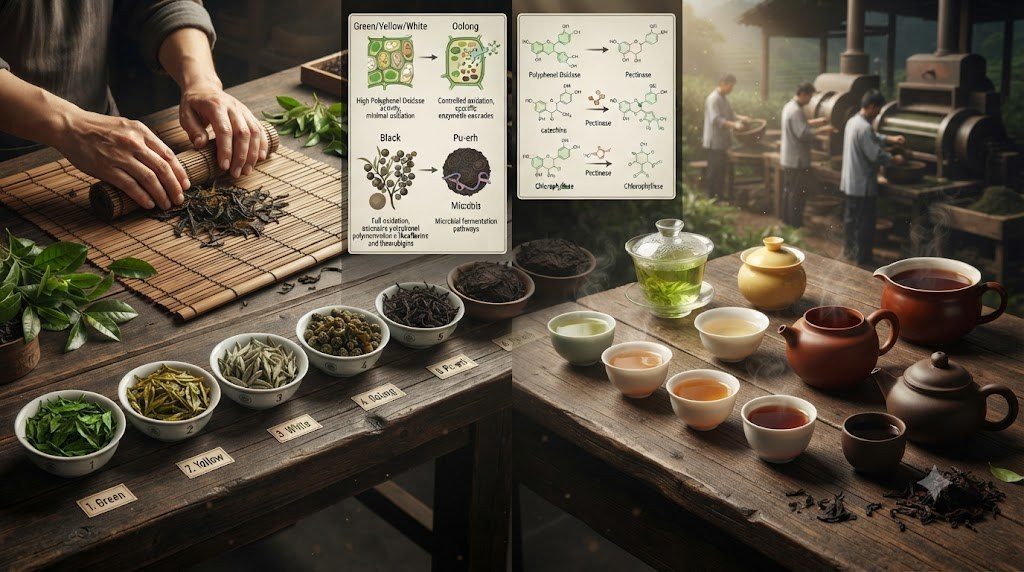
Oxidation is one of the most important processes in tea production. When tea leaves are bruised, rolled, or otherwise disrupted, enzymes can interact with oxygen and compounds naturally present in the leaves.
These reactions transform some of the leaf’s polyphenols and contribute to changes in color, aroma, and flavor.
Tea producers manage oxidation by controlling how leaves are handled, how long they are exposed to suitable conditions, and when heat is applied to reduce enzyme activity.
Green tea is typically processed to limit oxidation. Black tea is substantially oxidized, while oolong tea falls across a broad range of partial oxidation.
White tea generally undergoes minimal handling, but some oxidation can still occur during withering and drying. Therefore, it is more accurate to describe white tea by its gentle processing than to claim it is always completely unoxidized.
Green Tea: Fresh, Vegetal, and Light
Green tea is produced by heating harvested leaves relatively early in processing to reduce the enzymatic reactions responsible for oxidation.
Different traditions use different heating methods. Japanese green teas are often steamed, while many Chinese green teas are heated in pans or other equipment.
These methods help preserve a green appearance and contribute to distinctive flavor profiles.
Green tea may taste grassy, vegetal, sweet, nutty, or mildly marine, depending on the variety and processing technique.
Popular examples include sencha, dragon well, and gyokuro. Matcha is another form of green tea, made from finely ground, specially cultivated and processed tea leaves.
Green tea is a good starting point for people who enjoy refreshing beverages with relatively delicate flavors.
Black Tea: Bold, Rich, and Full-Bodied
Black tea is made by allowing substantial oxidation to occur before the leaves are dried. During processing, tea leaves are commonly withered, rolled or otherwise disrupted, oxidized, and heated or dried to stabilize the finished product.
These steps contribute to the darker leaf color and rich flavor associated with black tea.
Depending on origin and processing, black tea can develop malty, brisk, fruity, woody, or honey-like characteristics.
Examples include Assam, Darjeeling black teas, and many breakfast tea blends. Earl Grey is typically a black tea flavored with bergamot, although versions made with other tea bases also exist.
Black tea often stands up well to milk, making it popular in breakfast blends and milk-based tea drinks.
However, not all black teas are equally strong. Some are delicate and aromatic, while others produce intensely flavored cups.
Oolong Tea: A Wide Range of Flavors
Oolong tea occupies a broad processing category between green and black tea. Its leaves undergo controlled partial oxidation, although the degree of oxidation can vary significantly.
Tea makers may wither, shake, bruise, heat, roll, and roast the leaves in different combinations to create particular styles.
Lightly oxidized oolongs may taste floral, creamy, or fresh. More heavily oxidized or roasted versions can develop notes of toasted grain, dried fruit, nuts, or caramel.
Some oolongs are tightly rolled into small balls, while others retain long, twisted leaves.
Well-known styles include Tieguanyin, Wuyi rock teas, and Taiwanese high-mountain oolongs.
Oolong is especially interesting for curious tea drinkers because the category contains an unusually wide range of flavors and aromas.
White Tea: Delicate and Minimally Handled
White tea is commonly produced through gentle withering and drying, with less mechanical manipulation than many other tea categories.
Some white teas are made primarily from young buds, while others include both buds and mature leaves.
Because processing is relatively restrained, the finished tea can preserve subtle characteristics of the harvested material.
White tea often has a light body with floral, hay-like, fruity, or honeyed notes. However, some styles are surprisingly rich, especially after aging or when brewed more strongly.
Silver Needle and White Peony are familiar examples.
White tea can appeal to people who enjoy gentle flavors, but its delicate reputation should not be confused with a guarantee of low caffeine.
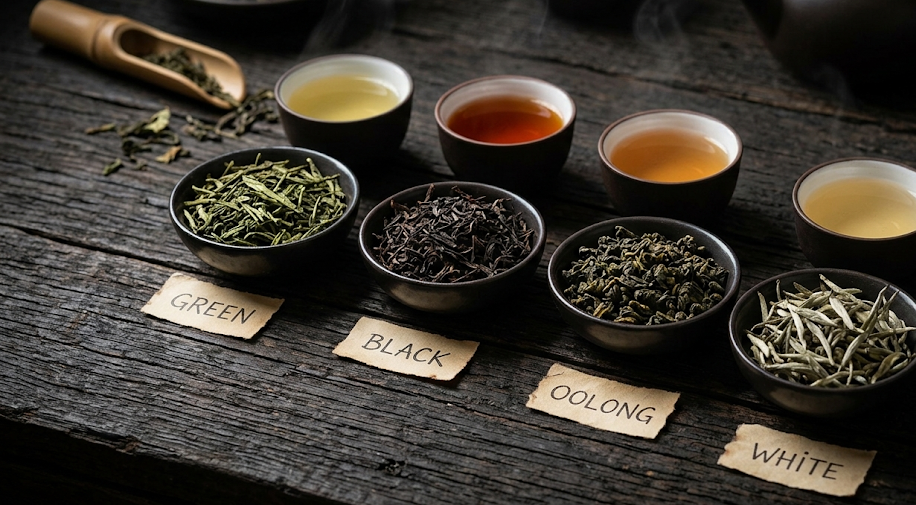
GREEN
Fresh & Vegetal
Usually heated early to limit oxidation.
BLACK
Bold & Malty
Substantial oxidation creates rich flavor.
OOLONG
Floral & Layered
Partial oxidation produces varied styles.
WHITE
Soft & Delicate
Gentle withering and drying preserve subtle notes.
Green vs Black vs Oolong vs White Tea: Comparison
Each tea category has recognizable tendencies, but individual varieties can differ considerably. Processing style, leaf quality, origin, and brewing conditions all influence the final cup.
| Feature | Green | Black | Oolong | White |
|---|---|---|---|---|
| Processing | Early heating | Substantial oxidation | Partial oxidation | Gentle withering and drying |
| Typical Flavor | Fresh, grassy, nutty | Malty, rich, brisk | Floral, fruity, roasted | Soft, floral, honeyed |
| Body | Light to medium | Medium to full | Light to full | Usually light to medium |
| Milk Pairing | Less common | Often suitable | Usually enjoyed plain | Usually enjoyed plain |
| Caffeine | Varies | Varies | Varies | Varies |
Which Type of Tea Has the Most Caffeine?
Black tea is often described as having more caffeine than green or white tea, but the reality is more complicated. Caffeine levels depend on the tea cultivar, growing conditions, harvested leaf material, processing, and preparation.
The amount of tea used, water temperature, and steeping time can strongly influence how much caffeine ends up in the cup.
Young buds and leaves may contain substantial caffeine, so white tea is not automatically the lowest-caffeine choice.
Matcha can also provide a relatively concentrated caffeine intake because the drink contains powdered tea leaf rather than only an infusion.
For people monitoring caffeine, product-specific information and brewing strength are more useful than relying entirely on tea color.
How Brewing Temperature Changes the Flavor
Even excellent tea can taste disappointing when brewed with unsuitable water temperature or steeping time.
Green tea is often prepared with water below boiling to reduce excessive bitterness and preserve delicate flavors. Many black teas tolerate hotter water and longer steeping.
Oolong and white teas vary considerably, so brewing instructions should be adjusted to the particular style.
The following temperatures are useful starting points rather than universal rules.
BREWING GUIDE / STARTING RANGES
Green Tea: Approximately 160–185°F (71–85°C), often 1–3 minutes.
Black Tea: Approximately 195–212°F (90–100°C), often 3–5 minutes.
Oolong Tea: Approximately 185–205°F (85–96°C), with steeping time depending on the style.
White Tea: Approximately 175–195°F (79–90°C), often 2–5 minutes.
Tea-to-water ratio also matters. Using more leaves produces a stronger infusion, while shorter brewing times may highlight lighter aromas.
For the best results, begin with the producer’s instructions and adjust gradually according to personal taste.
Does One Tea Type Have More Health Benefits?
All four true tea categories contain naturally occurring compounds, including polyphenols and caffeine. Their specific chemical profiles differ because of plant material and processing methods.
Green tea is often discussed for its catechins, while black tea contains oxidation products such as theaflavins. Oolong and white teas also contain a range of tea polyphenols.
Research has explored possible associations between tea consumption and several health outcomes. However, findings vary, and drinking one particular tea should not be treated as a proven method of preventing or curing disease.
For most adults, unsweetened tea can be a practical beverage choice as part of an overall balanced diet.
People who are sensitive to caffeine, pregnant, or managing certain medical conditions should consider individual guidance about caffeine intake.
How to Choose Tea Based on Your Taste
Personal preference is often a better guide than deciding which tea category is supposedly best.
If you enjoy fresh, grassy, or lightly nutty flavors, green tea may be appealing. Those who prefer stronger beverages with a substantial body may enjoy black tea.
Oolong is worth exploring if you appreciate complex aromas that range from floral to roasted. White tea may suit drinkers who prefer a gentler, more subtle cup.
Trying several styles within the same category can also be rewarding. Two green teas from different regions may taste less alike than their shared classification suggests.
Starting with small quantities allows you to compare varieties without committing to a large supply.
Loose-Leaf Tea vs Tea Bags
All four tea types are available in loose-leaf and bagged forms. The format affects convenience, but it does not automatically determine quality.
Loose-leaf tea often provides more space for leaves to expand and may allow greater control over brewing strength. Tea bags are convenient, consistent, and easy to prepare.
Some premium tea bags contain whole or large leaf pieces, while some loose-leaf products are relatively ordinary in quality.
Freshness, leaf condition, storage, and brewing technique often matter more than packaging format alone.
How to Store Tea for Better Flavor
Tea can gradually lose aroma and freshness when exposed to moisture, light, heat, and strong surrounding odors.
Store tea in a clean, dry, airtight container away from direct sunlight and heat sources.
Avoid placing tea near spices or other strongly scented foods because tea leaves can absorb surrounding odors.
Green and lightly processed teas may lose some of their fresh character more quickly than certain heavily roasted or oxidized styles.
Proper storage helps preserve flavor, but the ideal shelf life depends on the specific tea and how it was processed.
Frequently Asked Questions
Do green, black, oolong, and white tea come from the same plant?
Yes. All four are made from Camellia sinensis, although different cultivars and processing methods influence their characteristics.
What makes black tea darker than green tea?
Black tea undergoes substantial enzymatic oxidation during processing, contributing to its darker color and richer flavor.
Is oolong tea closer to green or black tea?
Oolong covers a broad range of partial oxidation, so some styles resemble green tea while others are closer to black tea in flavor.
Is white tea always caffeine-free or low in caffeine?
No. White tea naturally contains caffeine, and its amount varies with the leaf material and brewing method.
Which tea is best for beginners?
That depends on taste. Green tea suits people who enjoy fresh flavors, while black tea may appeal to those who prefer stronger beverages.
Can I drink all four tea types without milk?
Yes. All four can be enjoyed plain, although black tea is especially common in milk-based preparations.
Does brewing time affect caffeine content?
Yes. Brewing conditions influence caffeine extraction, although the amount also depends on the tea itself and the quantity used.
Final Thoughts
Green, black, oolong, and white tea demonstrate how dramatically processing can transform leaves from the same plant. Differences in oxidation, heating, rolling, and drying create distinct flavors, aromas, and appearances.
Green tea often emphasizes fresh and vegetal characteristics, while black tea is commonly richer and more robust. Oolong offers an especially broad range of styles, and white tea is frequently valued for its gentle processing and subtle flavors.
None of these categories is universally superior. The best choice depends on your taste, preferred brewing method, and how you want to enjoy the drink.
Exploring all four types is one of the simplest ways to appreciate the variety and craftsmanship found in the world of tea.