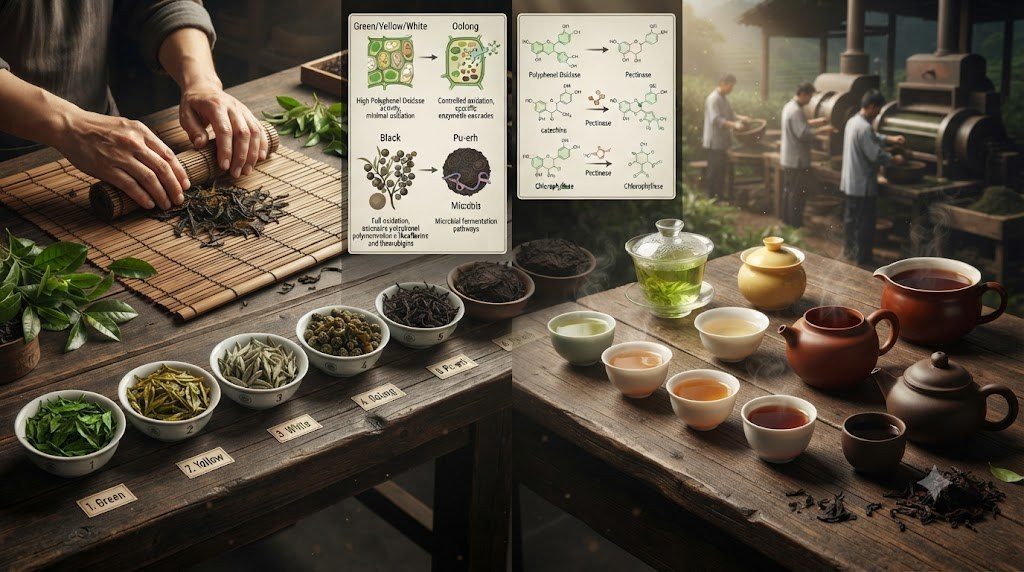
Freshly picked tea leaves can become a brisk black tea, a grassy green tea, a floral oolong, or a soft white tea. All four come from the tea plant, Camellia sinensis. Their differences begin with the leaves a producer picks and grow with every decision made after harvest.
Black tea is rolled or cut and given time to oxidize before drying. Green tea is heated early to limit oxidation. Oolong is bruised and partly oxidized before heating, while white tea mainly withers and dries. The finished leaves are then sorted and packed so they reach your cupboard in good condition.
From the field to the finished packet
A batch begins with soft, moist leaves and ends with something dry enough to store and ship. The sequence below follows the main production decisions. Each style uses its own combination of steps, and some stages overlap or happen in a different order.
-
Picking determines what the maker has to work with
The youngest growth on a tea bush appears as a tender shoot. A well-known picking standard is “two leaves and a bud,” meaning the unopened tip and the two young leaves below it. Some white teas are made mostly from buds. Some oolongs call for more developed leaves that can hold up through repeated handling and shaping.
Hand picking gives workers control over which shoots they take. Mechanical harvesting can cover more ground quickly and is common in some production systems. The useful question is whether the harvest suits the finished style. A batch destined for whole-leaf white tea presents a different sorting and handling challenge from one that will be cut into small particles for tea bags.
After picking, the leaves need room to breathe. Fresh material can warm up when it sits tightly packed, and rough handling can bruise it before the maker wants that to happen. Getting the leaves to the processing area in suitable condition gives the producer more control over what happens next.
-
Withering makes fresh leaves easier to handle
At the factory, leaves may be spread on trays or in long troughs where air can move around them. As they lose moisture, the leaves become pliable. A freshly picked leaf has a springy feel. A withered one bends and folds more readily, making it easier to roll or shape without the leaf behaving like stiff paper.
The maker adjusts airflow, the depth of the leaf layer, and the time the batch spends spread out. Leaves brought in after a damp morning can behave differently from leaves gathered on a dry afternoon. The maker checks the batch itself, including how the leaves feel and smell, before deciding when to move on.
Withering serves different purposes across styles. For many black teas, it prepares the leaves for rolling or cutting. For white tea, a more extended wither is central to developing the character of the finished tea. Some green teas are spread briefly before heating, while others move to heating soon after harvest.
-
Rolling, bruising, and cutting change the leaf inside and out
Rolling can twist a leaf into a strand, and repeated shaping can curl leaves into compact pellets. Pressure also breaks some cells. Once the leaf tissue is damaged, substances that were held apart inside the leaf come into contact, helping oxidation proceed when oxygen is available.
In orthodox black tea production, rollers work the softened leaves to break some cells while retaining recognizable pieces. In CTC production, rollers crush, tear, and curl the leaf into smaller particles. Those particles expose more surface to hot water, so a CTC tea can deliver color and strength quickly. This is one reason it is often used in tea bags and blends intended to take milk.
Oolong makers often use gentler handling during the oxidation stage. They may shake or tumble the leaves, then let them rest, repeating the cycle as the batch develops. The movement can bruise the edges while leaving much of the leaf intact. The familiar rolled shape of some oolongs comes later, after the maker has heated the leaves.
-
Oxidation and heat send teas down different paths
Think about the cut surface of an apple as it browns. Tea leaves also undergo reactions involving oxygen and enzymes in the plant tissue. During black tea processing, the rolled or cut leaves are usually held under conditions that let those reactions develop. Their color and aroma change before the batch goes into the dryer.
Green tea makers apply high heat early to inactivate the enzymes that drive much of this browning. Tea makers call this step fixation. Steam is common in Japanese green tea production, while a heated pan or drum is used for many Chinese greens. An oolong maker applies heat later, after the leaf has developed the aroma and degree of oxidation wanted for that batch.
White tea can undergo some oxidation as it withers, although the maker typically skips the deliberate rolling and oxidation sequence used for black tea. In dark teas that undergo microbial fermentation, microorganisms contribute to changes in the leaves. That process differs from the enzyme-driven oxidation that takes place when a black tea batch rests before drying.
-
Drying prepares the leaf for storage
By this point, the leaves may smell like tea, but they still contain too much moisture for ordinary storage. Warm air and controlled heat bring the moisture down. For black tea, the heat of drying also ends the main period of enzymatic oxidation. For green tea, fixation has already done that work and the dryer removes the remaining moisture.
Even drying matters. A thin, broken piece and a tightly rolled leaf can lose moisture at different rates. A maker may dry a shaped tea in stages so moisture from the inner parts of the leaf has time to move outward between passes. The dried batch is allowed to cool before subsequent handling and packing.
Roasting can add another decision. Some oolongs are roasted to develop aromas that recall nuts or toast. A lightly heated finish and a deeper roast can produce noticeably different cups even when the teas began with a similar leaf and went through a similar level of oxidation.
-
Sorting puts similar leaf sizes together
A dried batch can contain intact leaves, broken pieces, stems, and fine particles. Screens help sort it by size, and producers may use other equipment to remove unwanted material or separate pieces by appearance. Keeping similar sizes together makes a blend easier to brew consistently. Large leaves open gradually, while fine particles release flavor more quickly.
In some black tea grading systems, terms such as whole leaf, broken leaf, fannings, and dust describe physical size. A bag filled with small particles can deliver exactly the brisk infusion it was made for. A whole-leaf tea might be chosen for a slower steep or for a brewing vessel that gives the leaves room to unfold.
Sorting can be followed by blending. A producer selling a seasonal tea may pack one lot on its own to preserve its character. A company selling a breakfast blend may combine lots to keep the flavor familiar from one shipment to the next. Tasting brewed samples helps a blender decide which lots give the blend its strength, aroma, and finish.
-
Packaging protects the tea on its way to you
Dried leaves can pick up moisture and odors in storage. Packaging often includes a sealed inner pouch, foil barrier, or tight-fitting container to protect the tea from humid air, light, and strong smells. Depending on the product, the leaves may be packed loose, portioned into bags, or placed in bulk sacks before being repacked for retail.
Through a clear window, tightly rolled oolong may look compact and uniform, while a whole-leaf white tea can look bulky and irregular. Two packets of the same weight can therefore look very different. Once you open the pack, close it tightly after each use and store it in a cool, dry cupboard away from spices and other strongly scented ingredients.
Where the four styles take different paths
The order of heating, handling, and drying tells you more about the style than the color of the dried leaf alone.
| Style | Typical path after picking | What to notice when you brew it |
|---|---|---|
| White | Wither, then dry | Some styles brew a pale cup with delicate hay or honey notes. |
| Green | Heat early, then shape and dry as the style requires | Look for fresh vegetal notes in some styles and toasted notes in others. |
| Oolong | Wither, bruise and rest, heat, shape, then dry or roast | A light style may smell floral, while a roasted style may suggest toast or nuts. |
| Black | Wither, roll or cut, oxidize, then dry | Depending on the tea, expect flavors such as malt, dried fruit, or a brisk finish. |
What a packet can tell you about the process
Try looking at the dry leaves before you brew, then look again after you drain the cup. A pellet-shaped oolong may unfurl into recognizable leaves. A CTC black tea stays granular because it was cut before drying. That small comparison gives you a direct look at two decisions a tea maker made long before the packet was sealed.
Steamed or pan-fired
On a green tea label, these terms describe how heat was applied. They give you a useful clue when comparing a steamed green with a pan-fired one, especially if you want to explore the difference between vegetal and toasted flavors.
Whole leaf or broken leaf
These descriptions give you a clue about brewing time. If you switch from large leaves to a broken-leaf version, taste the infusion earlier. You may find it reaches the strength you enjoy before your usual timer goes off.
Questions about how tea is made
Can leaves from one tea bush become different types of tea?
Yes. A producer can process harvests from the same plants in different ways. Producers still choose varieties and picking standards that suit particular styles because the raw leaves affect the flavor, aroma, and how the batch handles during processing.
Are smaller leaves in a tea bag a sign of lower quality?
Particle size tells you more about how fast a tea is likely to brew than how it will taste. A fine-cut blend can produce a full, balanced cup in a short steep. Taste the tea at the strength you usually drink to decide whether it suits you.
Why do two oolongs taste so different?
Oolong gives makers room to vary the bruising, resting, shaping, drying, and roasting. A lightly oxidized oolong with little or no roast can smell quite different from a more oxidized oolong with a deeper roast. The tea variety, harvest, and brewing method also contribute to what ends up in the cup.